Spoiler alert:
This year I registered again to speak to this statewide policy-setting group: The Pennsylvania Opioid Misuse and Addiction Abatement Trust (POMAAT, or the “Trust”), established in May of 2022 and governed by a 13-member Board of Trustees.
Some of my colleagues feel like our time and effort will be wasted. By participating, are we simply supporting a performance of public engagement, rather than the meaningful public access they have refused to provide?
The blog post below about my experience last year was started a long time ago, then set aside as I juggled projects. It seems timely to publish it now, before the 2026 “Public Listening Session”.
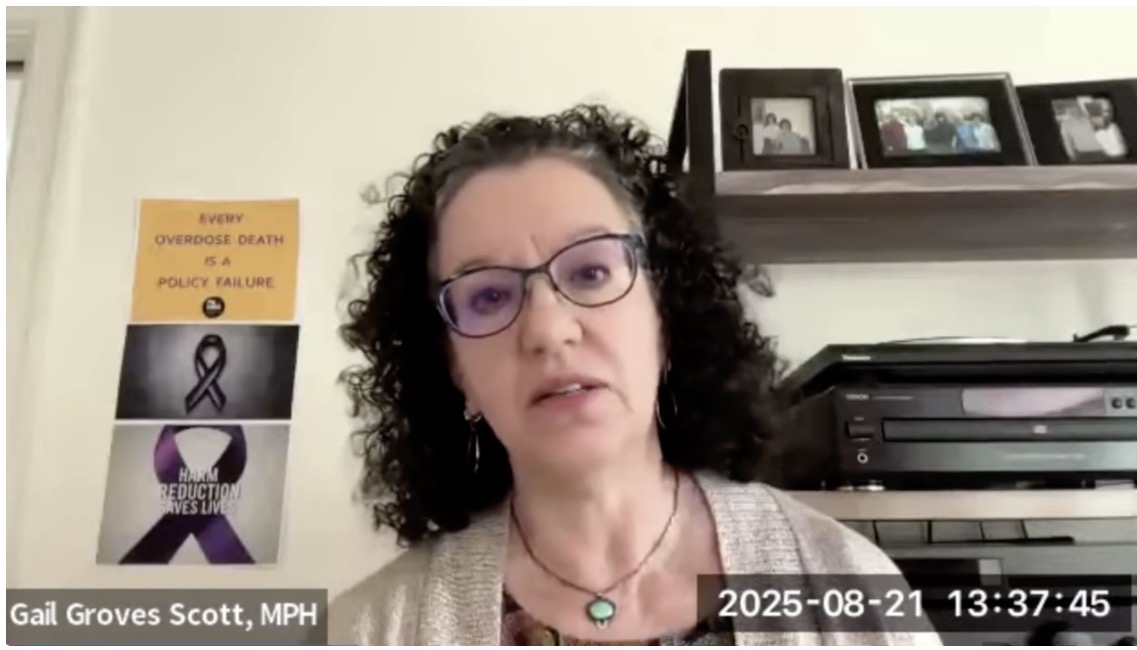
Gail speaking at the POMAAT 2025 “Public Listening Session” a hybrid statewide meeting.
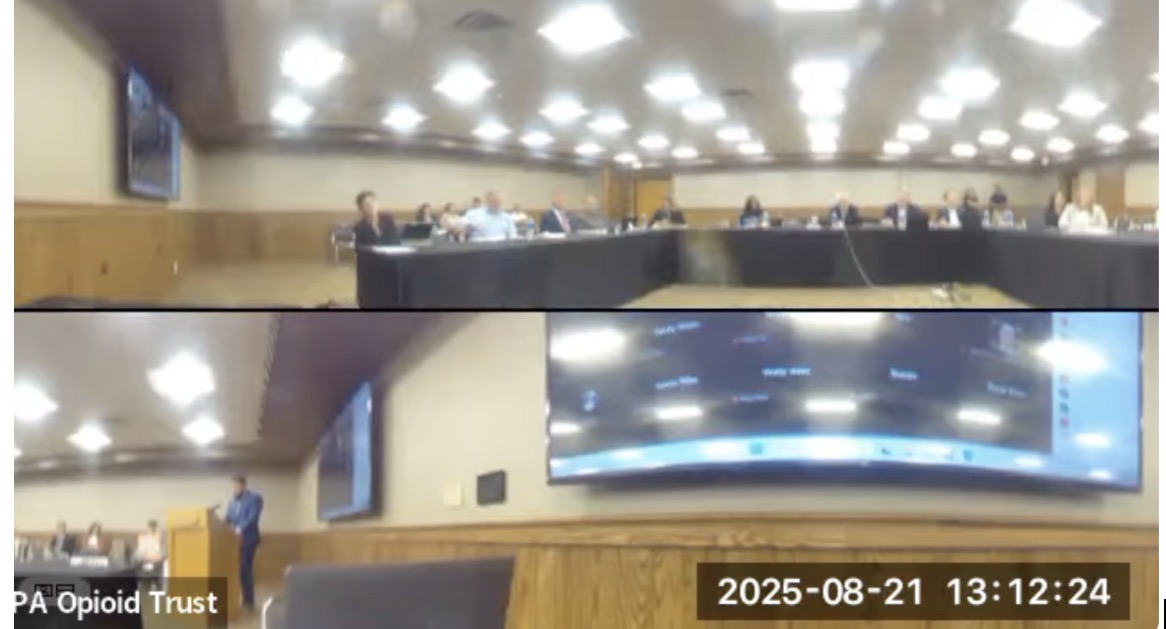
What do you have to hide? I asked Pennsylvania’s powerful state opioid settlement board in August 2025.
I was visiting family out of state, but I’d still registered to speak in the hybrid meeting on Zoom. As I set up my laptop, I carefully positioned framed family photos on the shelves behind me. They were my “easter eggs,” the hidden message only a few close family or friends might spot; inspiration for my public health policy advocacy work. In these pictures were two beloved young family members. Their lives sadly cut way too short.
With just 5 minutes to address the Trustees. I’d been repeatedly editing my remarks throughout the day, cutting topics I’d wanted to discuss because of the limited time allowed. We’d been told there would be no responses from the Board during the meeting. No dialogue allowed.
The majority of attendees at this hybrid meeting were viewing it online. Yet as the first speakers stepped up to the podium in the room, it became apparent that we would be able to hear the speakers but barely see them because of the odd, distant camera angle, apparently from a laptop. The view of the podium and board members was too blurry for viewers online to make out their expressions.
My turn came. I smiled into my laptop camera at the audience I couldn’t see. I introduced myself as a parent, researcher, and former pharma employee. I described my expertise in areas directly related to the work they’d been tasked with overseeing, including my research on access to medications for opioid use disorder.
I’d been a whistleblower who helped the federal government prosecute opioid companies. I’d testified before a grand jury in the Purdue Pharma case. Their long-delayed settlement was about to be finalized for $7 billion.
This is personal to me — how these funds are being spent.
My tone was curious, perhaps a bit exasperated, not angry. I respected the Trustees’ time commitment to this public service. I believed they recognized the significance of their stewardship over billions of dollars. Money meant to remediate an overdose epidemic. Money that could flexibly address local needs, filling at least a few of the many gaps in access to opioid use disorder treatment, recovery support, and overdose prevention. Settlement funds that are often described as “blood money.”
I didn’t hesitate, though, to politely but pointedly call out their Chair, Tom VanKirk.
I think you’ve lost sight of who your client is here.
You are representing me;
you are representing the public, to see that this unique and finite stream of funds is not wasted.
I’d met Mr. VanKirk the year before, when I showed up for the first public Board meeting in Harrisburg, that the public could attend in person. Several Trustees attended online, but those who attended the Harrisburg meeting avoided speaking with me in the hallway. It felt as if chatting with public attendees was somehow unseemly. Or were they uncomfortable with the controversies their Chair had sparked?
I managed to have a brief conversation with Mr. VanKirk on the first day, as he tried to rush out. A retired attorney, he struck me as affable and enthusiastic. He had already devoted many hours of his retirement to this community service. But I didn’t understand his blind spot about transparency and accountability to the public.
The early secrecy of this board’s meetings have been well documented:
- The board’s leadership has been dismissive of the Sunshine Act despite claiming that they follow it.
- You hired multiple vendors and contracted for professional services without putting out a public request for proposals or a bid process.
I was concerned that the Trustees chose to hire the law firm where Mr. VanKirk had practiced for 41 years in a non-competitive process. But we had no opportunity to raise questions in real time during the Trust meetings. They also chose their research partners, management, website designer, and purchased other services in private, no bid deals.
Not only was there little concern about the appearance of conflicts of interest, or the norms of contracting for services with public money, the Trust blocked access to the contract details.
If these decisions were sound—if the process was fair—why were they blocking us from reviewing the contract details that could potentially put our concerns to rest?
Your transparency got a rough start, in our view; but you’ve been doing better in some ways.
It turned out we shared the view that settlement funds were not intended to fund county prosecutors or policing, an issue I was battling in Lancaster County. Still, I told Mr. Van Kirk that the county policymakers were frustrated by the Trust’s slow start to provide them clear guidance.
Our brief interaction didn’t have much influence on Mr. VanKirk. It was almost two years later that I was once again speaking to him directly. Perhaps the national attention to this issue, or internal pressures, led to the minimal concession to public engagement: this first Listening Session.
You have made the choice to oppose and litigate requests for transparency, instead of just being transparent.
So far, Mr. VanKirk has been successful in a troubling effort to shield the Trust’s financial and administrative records from the standard scrutiny allowed of government documents under PA’s Right to Know Law (RTKL). The Trust’s odd status as a creation of the court, and not of state or local government, isn’t described in the language of the RTKL. PA Spotlight and its reporter, Ed Mahon, lost an appeal to access these documents.
Former Trustee PA State Senator Greg Rothman actually raised multiple red flags:
- the Trusts’ spending on litigation.
- closed “working group” meetings where major decisions are made.
- private executive sessions.
Senator Rothman stated that the Board was likely violating PA’s Sunshine Act at Mr. VanKirk’s “unilateral direction,” PA Spotlight reported in 2024. Senator Rothman resigned as a Trustee before the August 2025 meeting.
I wrapped up with a short call to action for the Trustees for their next meeting:
I ask this board to make a motion: to allow public input, not only public comment periods at the end, but input before voting.
To get input from the experts who could help you with the complex decisions you were making – before you vote. That public dialogue that is sadly missing today.
My closing sentence was to introduce our child’s experience with harm-reduction interventions, but I was interrupted by Chairman Van Kirk. The Zoom window was closed, and the next speaker began.
To be honest, I felt some optimism at this point. Maybe our calls for more transparency, more accountability were heard?
If a majority of the Trustees chose to vote for transparency reforms, they wouldn’t need the Chair’s assent. They weren’t appointed to their positions by Mr. VanKirk, but by legislative or association peers. Their roles weren’t at risk if they asserted themselves.
At their next Board meeting, no reforms were initiated or discussed publicly, to my disappointment.
My pointed questions, my call-out of Chair VanKirk, my own expertise and connection to these funds, and my call for reform were omitted from the meeting minutes‘ bland 1-sentence summary of my speech.
The full meeting can be viewed online, as well as the other public Board meetings since March 2023. The uneven audiovisuals make some hard to sit through. Is that the point?
I’ve extracted my 5-minute 2025 talk for you to view here. Feel free to email me your thoughts.
Video: https://youtu.be/BCyCWNAsYFg?is=SYCc3XOZQlvKnbIT
Transcript: Opioid Trust Transcript PDF
Will anything be different at the Thursday, August 6, 2026 “Public Listening Session”?
It’s not looking likely, so far.
A coalition of policy advocates held a press conference after the August 2025 meeting. We decided we needed to hold one in 2026, too.
Last year, some attendees mentioned the unwelcoming tone we felt at POMAAT’s first Listening Session. The way the 2026 Public Listening Session was announced and managed couldn’t make it any clearer: this event is meant to be performative. The Trust is checking a box called: “public engagement” but they really don’t care if anyone attends.
I will leave out the details on how unsettling it was for advocates to drive hours, paying their own way to this meeting, and be treated, not as guests, but as adversaries, once again.
Suffice it to say, both the hybrid, and the in-person speakers noted an absence of even the most basic of polite gestures, or inclusion— things one normally provides to “welcome” participants at a professional meeting.
This year’s pre-registration isn’t going well, we learned in July.
Why isn’t anyone signing up? Nothing is user-friendly. If you do find it, the sign-up form lacks sufficient information.
The meeting’s August date, the time, and the rural resort locations are inconvenient for the public.
They do no outreach about the program. No promotion at all.
Confusion reigns even about the point of the sessions! In both years, people have registered thinking they were coming to “listen” to the Trust, unaware that they were supposed to be making a presentation themselves.
We thought maybe the event could be salvaged. So we sent the Trust this letter.
We requested the full time allotted for the session. We pointed out that, once again, the pre-registration process was arbitrary and opaque.
We provided suggestions on how they could do better.
They don’t want to do better.
I conclude this because the 2026 “listening” session was quietly cut in half, from the scheduled 1.5 hours to 45 minutes. That’s because only 5 people managed to register this year, only 4 of whom actually understood they were signing up to be a speaker.
Even at the last minute, implementing some of our suggestions would have boosted participation this year. The Listening Session could have at least seemed more productive. But they weren’t interested.
It seems like a small thing, but to us, it said volumes: Speakers’ names, affiliations, and the speaking order were not listed in the 2025 agenda or newly posted 2026 agenda.
This is a minimum courtesy you extend to attendees at a professional meeting, or the journalists covering it, that costs you nothing.
It’s almost comical how hard the Trust is trying to make it clear public engagement is not needed or wanted. Except it’s also sad.
I emailed POMAAT’s administrator, Brie Anderson to follow-up.
I noted that boards serving the public in our Commonwealth frequently allow public comment from any members of the audience or provide an on-site registration process. We’d already explained that we knew people who wanted to speak, but didn’t learn how to register in time. Some of them would participate, given the chance. So I said:
- The way public comment is managed is an arbitrary choice by the Board’s leadership.
- Public comment protocols are not described in your bylaws. To our knowledge, they have not been publicly discussed and voted on by the Trustees.
- You can change them at any time.
On Tuesday afternoon, I received a response. It sounds like it was written by a lawyer, with words like “albeit”.
(It occurs to me- hopefully Mr. VanKirk wrote it, and they aren’t spending settlement dollars to pay attorneys to craft emails to their own program participants?)
It can be summed up this way:
Nope. We listen to you voluntarily, not because we are obligated to. We said what we said.
We will not change our protocols.
Best regards!
Woo, hoo. We can get out early now, time to go take our kids/grandkids/selves swimming in the resort waterpark! (I am guessing about this part).
Next steps:
Two Trustees messaged me after my talk in 2025, and I replied, but we didn’t meet in person. I haven’t had the bandwidth over the past year to reach out individually to the Trustees, although some other advocates have. I regret this. I enjoy meeting with legislators and other policymakers.
Keeping boundaries around the time I need for the last year of my dissertation research has been challenging. I have had to drastically cut back on in-person advocacy. It will be a different story a year from now. And I am nothing if not tenacious, especially when billions of dollars are at stake.
The Trust created performative Listening Sessions when external and internal criticism began to land.
A group of parent advocates, led by Susan Ousterman, has proposed amendments to the Commonwealth Court order, seeking support from the Governor’s office. Governor Shapiro has stated he “expects transparency” from the Trust.
The parent advocates called on Governor Shapiro to appoint a new POMAAT Chair.
I agree.
Pennsylvanians deserve to see settlement dollars managed by leaders who understand that best practices include meaningful public participation, not performances of inclusion.
Learn more:
Spotlight PA’s excellent coverage of the POMAAT and opioid settlement spending statewide
https://www.spotlightpa.org/series/opioid-settlement-money/
See coverage of Lancaster County’s opioid settlement decisions on my In the News page, under Opioid Settlement Fund Advocacy.
PA Opioid Settlement Database
https://www.paopioidsettlementdata.org/
PA Spotlight Opioid Settlement Spending Database
https://www.spotlightpa.org/news/2024/11/pennsylvania-opioid-settlement-money-spending-data/
Pennsylvania Opioid Settlement Tracker (Vital Strategies)
https://www.opioidsettlementguides.com/pennsylvania
See my Resources page for more.
Recent Comments